Coins bearing the image of Diadumenian
from Seleuceia ad Calycadnum
This ancient city called Seleuceia
(by which the modern town of
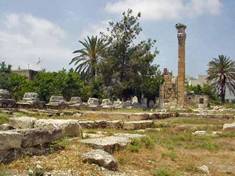
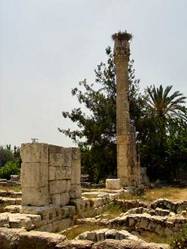
Figure 1 Figure 2
(Images courtesy of http://www.anatolia.luwo.be)
Figures 1 and 2 show the remains of the
While examples showing Macrinus also exist there appears to have been two denominations issued specifically for Diadumenian at this mint – during the year or so that Macrinus was in power. One, at 20-21mm and 4-6g and a larger type 28mm and around 11.5g, each with two distinct reverse types associated with them.
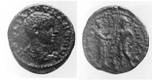
Example 1
Ob,
M OΠ DIADOV ANTΩN K
Rev. CELEVKEΩN
Ref. Lindgren 1583
(illustrated with permission);
21mm, 6.1g,
Example 1 shows a reverse of Athena and Dionysus. The example is scanned from the Lindgren 1 publication so the image is unfortunately not very clear. However, it does appear that the obverse die is different from that seen in Example 2 – which is of a similar size. Athena and Dionysus are two important Greek gods and it is common to find them venerated in cities of Greek foundation, though it is very unusual to find them together on the reverse of a single coin. Two coins showing Dionysus reverses minted during the reign of Caracalla can be found (SNG Levante 747, 748) as can an Athena standing reverse (SNG Levante 723) for Antoninus Pius, so the images have been represented at this city before Example 1 was minted and coins under Gordian III also depict the two deities (SNG Levante 763, 764, 775) later in the chronology.
Example 2

Ob. M OΠ DIADOV ANTΩN K
Rev. CELEVKEΩ/N
Ref. BMC no. 32, plate xxiv 3
3.34g 20mm,
The reverse of Example 2 shows a humped bull (zebu) standing left with a star and an upturned crescent above. The obverse, in keeping with most of the provincial output of Diadumenian, is bare-headed, draped and shown in the “seen from behind” pose. The only coin of the series not to ‘overtly’ depict a divinity, this image can be seen on the coins of Seleucus I, Nikator himself, so the representation obviously has been held in high regard by the inhabitants of the city for a long time. The presence of the crescent and star suggest an astrological/religious connotation for the image, though, of course, the symbolism of the star does not necessarily represent a physical, single solar object, for example, twin stars on certain imperial coins have been thought to represent the Dioscuri.
This use of the image of a single star and crescent seems to be different from the multiple stars and crescent imagery that can be found on other coins in antiquity, particularly during the Hadrian through Severan Dynasty period. The crescent almost certainly represents the moon (or a divinity closely associated to it), the star could represent a single star (Venus being the most obvious), a group of stars such as the Pleiades, or is the representation of a god – all the options have been put forward. The crescent and single star can be seen on coins as early as 341 BC when the city of Byzantium counter stamped its coins, in tribute to Hectate, as a mark of gratitude for being spared the ravages of Alexander’s army, and continues on into the first millennium (and beyond) with, for example, many of the Sassanian Dynasty’s output of the fire altar, crescent and star motif.
This depiction of a crescent and star can be seen on other provincial
coins of the time, for example, the reverse of a Gallienus AE30 from Pamphylia
(SNG Auk 4731) shows a temple of Artemis Pergeia
(pre-Hellenic goddess) surmounted by these two symbols. An
AE30 of Severus Alexander from
To date there appears to be no consensus or even any satisfactory conclusion to the proper meaning of this symbolism other that it was ‘religious’. Indeed as it has survived to this day in the emblems of some Middle Eastern countries, it is probable that its meaning also shifted over time and placement throughout antiquity.
The image of the bull here also likely has a religious
connection. One of the most commonly recognised
depictions of a bull is that on the Imperial issues of Julian the Apostate (usually
referred to as the Aphis bull of Egyptian
origin) seen some 40 years later. This connection was first made by J. Eckhel but has been disputed by later writers due to the
differences seen in the imagery from the source at
Example 3a Example
3b
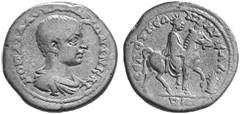

Ob.
M
OΠ ΔIAΔOV ANTΩNIN KAI Ob. M OΠ ΔIAΔOV
ANTΩNIN KAI
Rev. CEΛEVKEΩ-N
KAΛVKAΔNQ Rev. CEΛEVKEΩ-N
KAΛVKAΔNQ
Ref. Numismatik Lanz München,
Auction 117, cng coins Sale 64 Lot No. 678
November 24th, 2003
(illustrated
with permission); SNG
Levante 754;
11.55g 28mm 11.27g
28mm
Examples 3a and 3b show the usual bareheaded and draped bust right – this time using a frontal orientation, though both of these dies are different. The reverses show a robed and radiate figure seated on a horse, advancing right, with a garlanded altar before. The type can also be seen on bronze coins of Severus Alexander, Gallienus and Trebonianus Gallus, and silver tetradrachms of Hadrian and Geta. Interestingly, the design of the reverses for these other rulers is almost exactly like this one, suggesting that the image is taken from a local, permanent feature such as a statue or that the figure is a venerated deity rather than a more transient ruler.
Example 4

Ob.
M
OΠ ΔIAΔOVMEN[...] ANTΩN KAI C
Rev. CEΛEVKEΩ-N KAΛVKAΔ/N/Q
Ref. Same
dies as Gorny & Mosch Giessener Münzhandlung Auction
117, 14th Oct. 2002, No 404
11.23g 28mm
Example 4 shows the same obverse die to Example 3 where the legend has been continued around and under the bust. The reverse shows an impressive, full bearded Herakles standing, nude to waist and wearing ornate boots, leaning on club with right hand and holding slain boar with his left hand. This reverse depicts an early labour of Herakles, the capture of the Erymanthian Boar. While this is not the most common of Herakles reverse types seen on Roman provincial coins, examples of others do exist including one for Severus Alexander from Callatis in Moseia Inferior, and one for Julia Domna from Sebastopolis-Heracleopolis in Pontus.
Overall, this is a very tidy series with two denominations and neat, interesting and well executed designs on the coins. The obverse shows Diadumenian in one of his older depictions and generally rather stern looking. The coins are of standard manufacture being of a comparable size to weight ratio to other coins of the region and time.
Malcolm Megaw
August 2007
References;
Coinarchives (www.coinarchives.com)
Lindgren and F. L. Kovacs; Ancient Bronze Coins of Asia
Minor and the
Historia
Numorum, a Manual of Greek Numismatics; B. V. Head,
The Sassanian Dynasty; Kerr,
Mitchiner, Michael, Oriental Coins and their values. The Ancient
and
Classical World, 600 BC/AD 650, Hawkins Publications,
Mattingly H. The Date of Virgil's
Death: A Numismatic Contribution
The Classical Review,
Vol. 44, No. 2 (May, 1930), pp. 57-59
The Complete Dictionary of Symbols, Chronicle Books, 2005, ISBN-10: 0811847675
Vanderspoel, di John, Julian and the mithraic
bull. The
Ancient History Bulletin, 12/4
(1998), pp. 113-119